
Circular economy action plan COM(2020) 98 final
The European Commission has presented a wide range of initiatives dealing with circular economy. Initially, the focus was on resource extraction and waste, but over time the topic was expanded to cover dangerous substances, resource efficiency, and ultimately a complete action plan aligned with the Green Deal’s goals.
The 2020 Circular Economy Action Plan (COM(2020) 98 final) specifically addressed construction with the following actions:
- Address the sustainability of construction products through the revision of the Construction Products Regulation, potentially including the introduction of recycled content requirements.
- Promote the durability and adaptability of buildings and develop digital building logbooks.
- Use Level(s) to integrate life cycle assessment into public procurement and the Sustainable Finance Taxonomy, and explore the setting of carbon reduction targets and the potential of carbon storage.
- Consider a revision of material recovery targets for construction and demolition waste.
- Increase the use of excavated soils.
- Launch the Renovation Wave to significantly improve energy efficiency.
- Widen the Ecodesign Directive into the Sustainable Product Initiative (SPI).
Regarding construction, the European Commission indicated that it will address high-impact intermediary products such as steel, cement, and chemicals, with additional product groups identified based on their environmental impact and circularity potential.
The “toxic-free environment” concept was introduced and linked to the Chemicals Strategy for Sustainability. This strategy addresses the interface between chemicals, products, and waste legislation and involves the implementation of the SCIP database as regulated under the Waste Framework Directive.
A one-size-fits-all approach to circularity will not work in construction due to the diversity of materials and the long service lifetimes.
The crucial element of the Circular Economy Action Plan is the reintegration of resources into European material cycles. However, this is particularly challenging in construction, where the design phase impacts material recovery only in the long term, and immediate actions must address the demolition and reuse of existing structures built decades ago.
Environmental Product Declarations according to EN 15804 provide reliable information on circularity but are not sufficient on their own to promote circular design. Issues such as legacy substances and the limited availability of secondary materials continue to pose challenges. Therefore, initiatives like the EU Construction and Demolition Waste Package are critical to promoting reuse, repair, and recycling within the waste hierarchy.
In all cases, the cornerstone of a more circular construction sector is information, and the Construction Products Regulation has proven to be the most effective tool for managing this in the complex European market. EU chemicals legislation complements this by providing necessary regulatory frameworks for certain substances and admixtures.
Future developments: Under the 2025 Clean Industrial Deal, the Circular Economy Action Plan is expected to be replaced by a new Circular Economy Act, scheduled for publication in 2026. In EU terminology, an Action Plan outlines strategies, intentions, and proposed initiatives without binding force, whereas an Act is a legally binding instrument that sets specific obligations directly applicable to Member States and economic operators.
The new Circular Economy Act is anticipated to:
- Establish requirements on the use of secondary raw materials.
- Strengthen obligations for circular product design across key sectors, including construction.
- Set clearer targets for resource recovery and waste minimisation.
- Introduce enforceable monitoring and reporting frameworks on circularity indicators.
This transition from an action plan to an act signals a significant shift: from encouraging circular practices to making them legally binding, ensuring faster and more uniform implementation across the European Union.(1)
(1) European Commission, Securing Europe’s Competitiveness through a Clean Industrial Deal (COM(2024) 72 final), February 2024. The Communication outlines the forthcoming transition from voluntary circular economy initiatives to binding requirements, including anticipated measures on secondary raw material use, circular product design, resource recovery targets, and enforceable monitoring frameworks, with the Circular Economy Act expected in 2026.
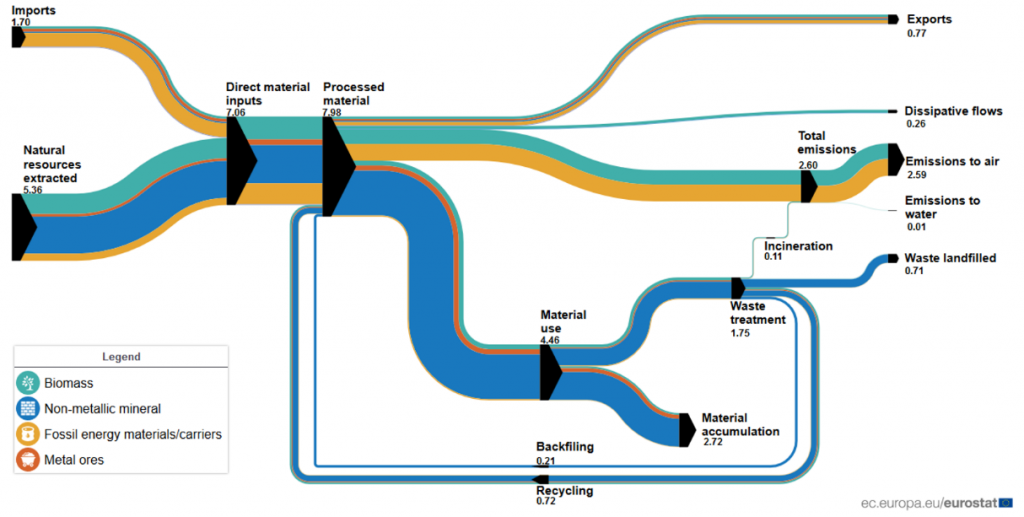
Sankey diagram of material flows, European Union 2017 – Source Eurostat